
Architects of Digital Health
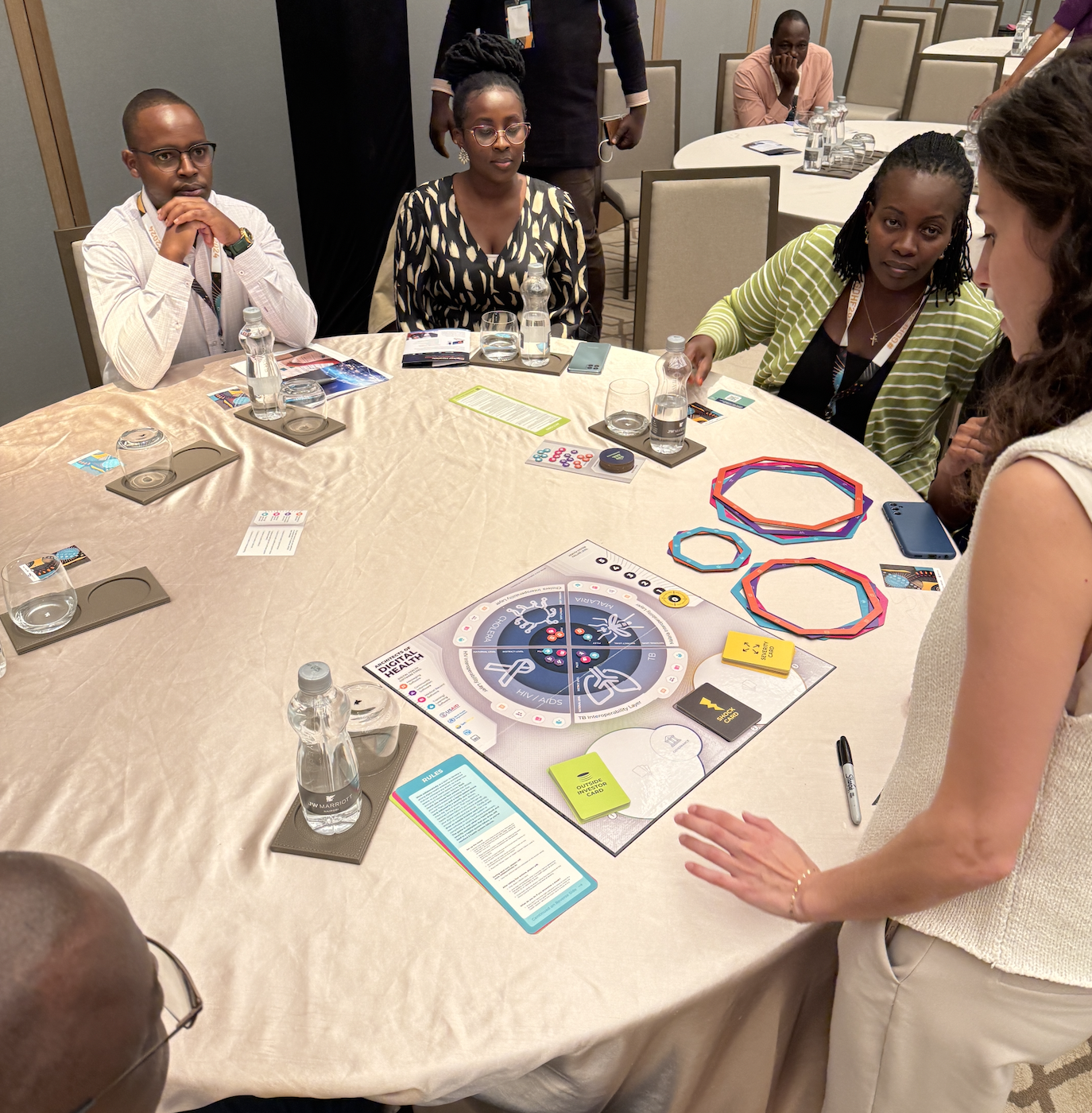
A new Minister of Health has just pulled you onto the Digital Health Task Force. Your job: coordinate the country's fragmented digital health systems into one national architecture that can withstand any shock. The board game built into DH:PNS, playable in cohorts around a table, or right here in your browser.

The lite version, in your browser.
A single-team digital adaptation of the tabletop rules, played on the real board: four actions a round, then a shock, a severity, and an outside investor. Add a system for 1 action, defragment for 1, scale pilot to district for 1 or district to national for 2, interoperate for 2, or bank governance for 1. Win by getting every system into the interoperability layer at national scale before five health system failures pile up.
Faithful to the tabletop action costs. You can scale any single system on its own, pilot to district for 1 action and district to national for 2, without interoperating first. Interoperating costs 2 actions and needs the same system in at least two disease areas on the same level; it places the ring at that level, and from then on new investments in that system land straight in the interoperability layer. Scaling an interoperated ring takes every system in that layer up together, which is what makes coordination pay. A shock is only blocked if that specific system is present in that disease area at or above the severity level... a ring alone will not save you. Duplicated systems (two overlapping hexagons) must be defragmented before you can scale or interoperate there.
Build a health system that can withstand anything.
Teams work collaboratively to build a digital health enterprise architecture across four disease areas... Cholera, Malaria, TB, and HIV/AIDS... using four types of software systems. Each round you choose four actions: add systems, defragment duplicates, scale from pilot to district to national, invest in interoperability, or bank governance.
Then the world happens. A shock card hits a disease area, a severity card sets how high the bar is, and an outside investor drops new software into your ecosystem, whether it fits your plan or not. Withstand every shock before five health system failures pile up, and you win.
Created by Merrick Schaefer & Nick Martin · developed with USAID, WHO, ITU, TechChange & Digital Square

The pieces.
Software System Tokens
Four types: Messaging, Community Information, Medical Records, and Training/Learning, the technologies your team deploys.
Interoperability Rings
Placed when you connect software of the same type across disease areas into a common architecture. They stack as you scale.
Shock Cards
Power failures, outbreaks, fires, malware. Each shock tests a specific software type in a specific disease area.
Severity Cards
Sets the level of the shock: pilot, district, or national. Your defenses have to be scaled at least that high.
Outside Investor Cards
New money arrives every round, on the investor's terms. It can strengthen your architecture or fragment it further.
Governance Tokens
Invest in governance ahead of time to redirect outside investments toward your priorities. Coordination, as a game mechanic.
Watch a live session.
A walkthrough of the game in action with a real cohort.
The pedagogy, disguised as play.
Every mechanic maps to a real planning concept from the course: fragmentation is duplicated software you must defragment before you can scale; interoperability is the only durable defense; governance converts outside money from a risk into a resource. Cohorts feel the enterprise planning approach before they're taught the vocabulary for it.
Fragmentation, felt
Donor-driven investor cards keep dropping duplicate pilots into your ecosystem, exactly the dynamic real planners face.
Interoperability compounds
You can scale one system at a time, and plenty of teams try. But an interoperated ring scales every system in the layer at once, and new donor money lands inside the architecture instead of beside it. The arithmetic of the game teaches the thesis of the course.
Governance pays off
Investing an action in governance seems wasteful, until it lets you steer the next investment to where the system actually needs it.